
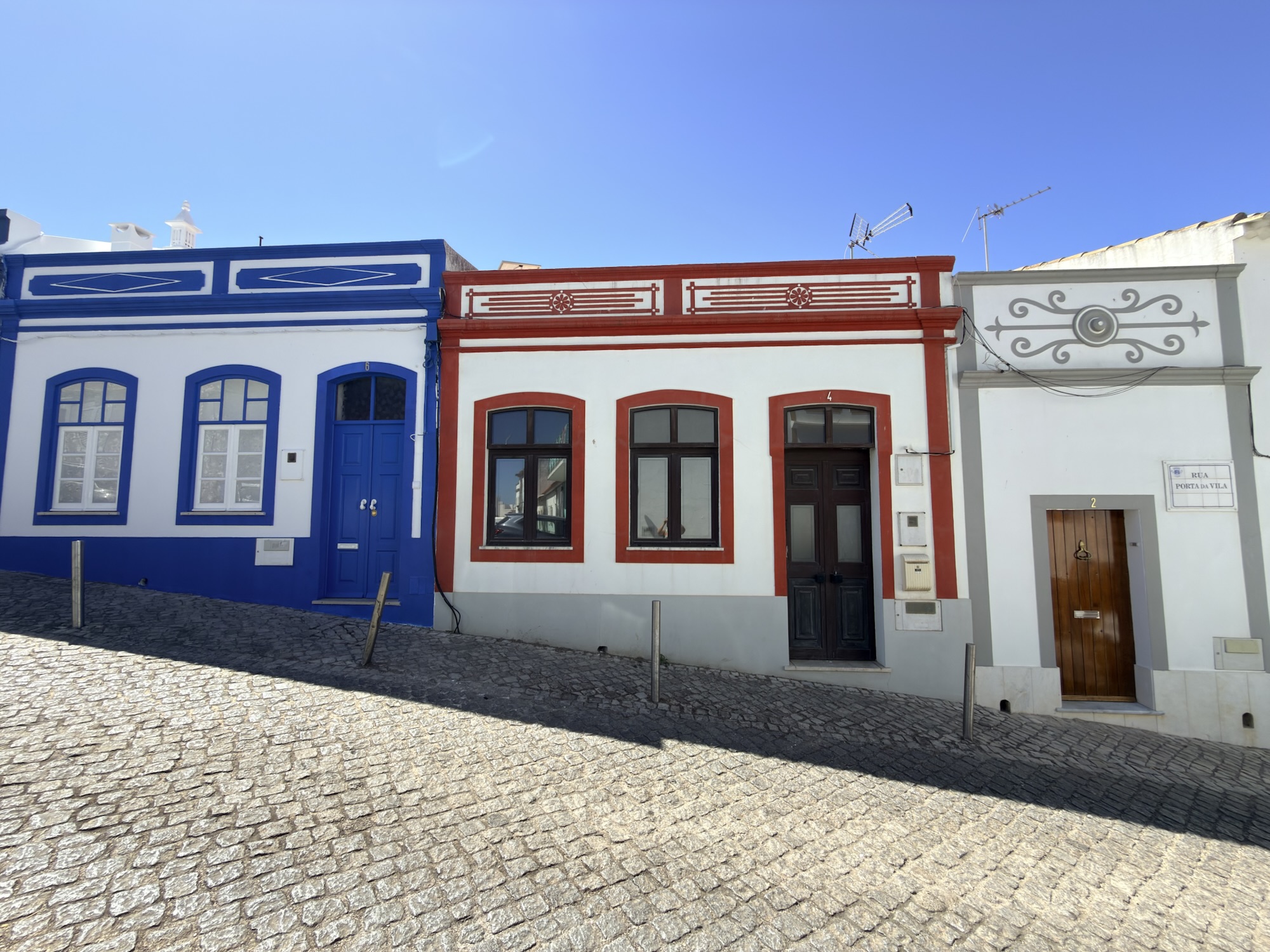
This is our first time in Portugal, and rather than settle into one corner of the country, we decided to try a bit of everything. Over a month, we traced a loop from north to south: starting with the port lodges and tiled churches of Porto, drifting up the terraced hills of the Douro valley for wine, then working our way down through the university town of Coimbra and the walled, bone-chapelled town of Évora. From there we swapped the car for our boots and walked a stretch of the Fishermen’s trail along the wild southwest coast, before easing into the beaches and cliffs of the Algarve around Lagos and the barrier islands off Olhão. We finished in Lisbon, with an overnight stay in Sintra for its palaces.
If you’re planning something similar, the sections below break the trip into bases you can lift, stretch, or trim to fit your own time.
Map of everywhere we’ve stayed on this trip.
At a glance
Duration: 31 days
When we went: late August – mid September 2026
Style: cities + wine country + ruins + hiking + beaches
🚊 Getting around
- Rental car for city-to-city phases in the north;
- bus + ferry for short distances;
- rental car in the south but could have been public transit.
🧭 Route
- ✈️ Fly into Porto, stay 4 nights
- 🚗 Drive to Pinhão (Douro), stay 2 nights
- 🚗 Drive to Coimbra, stay 2 nights
- 🚗 Drive to Évora, stay 3 nights
- 🚗 Drive to Lisbon and 🚌 bus to Porto Covo to get to the Fishermen’s trail, village to village hike for 2 days (3 nights)
- 🚕 Uber to Sagres (can be a bus but will take a full day) for 2 nights
- 🚌 Bus or 🚕 Uber to Lagos, stay for 3 nights
- 🚗 Pickup a car and drive to Olhão, stay for 3 nights
- 🚗 Drive to Lisbon, stay for 2 nights
- 🚊 Train to Sintra, stay for 1 night
- 🚊 Train back to Lisbon, stay for 2 nights
🏆 Best places we’ve eaten on the trip
- Dinner → Essencial (day 29) in Lisbon
- Coffee → Nau Coffee (day 9) in Coimbra
- Brunch → Black & White (day 20) in Lagos
- Cinnamon Buns → Quest (day 30) in Lisbon
The full trip details
📍Porto – 4 nights
The connexion between OPO and downtown Porto is easy using the metro system straight from the Airport. As the metro system supports contactless payment straight at the gate we didn’t even need to figure out ticketing. The rest of the city is very walkable. Worst case it’s a short metro ride. We spent four nights here but it’s more of a 2 to 3 nights city. The port tasting experience is not to miss of course but don’t over do it and choose well. (See the day 3 log or more details).


🏆 Best of Porto
- Restaurant → Mito (day 2)
- Port tasting → QUEVEDO (day 3)
- Pastel de Nata → Castro
- Coffee → 7g coffee (day 3)
- Brunch → CA Downtown (day 6)
✍️ Detailed log entries with pictures
- ✈️ Day 1: Travelling to Porto → the long haul over to Portugal and into Porto
- ☕ Day 2: First half-day in Porto → dropped the bags and eased in with a first wander around the city
- 🍷 Day 3: Port tasting → across the river to the cellars for the obligatory port education
- 🥘 Day 4: Visiting the market → poking through the market stalls and eating our way along
- 🥪 Day 5: Francesinha → tracking down the monstrous meat-and-cheese sandwich
📍Pinhão – 3 nights
The Duoro valley is accessible by train from Porto. Some people even make a day trip to Pinhão or other places within the Valley. Pinhão, to us, seemed like a comfortable town with good food options and conveniently located to explore the valley if you have a car. The town is also much quieter in the evenings than mid-day when the tours are in town. We went there for the wine and the stone carvings. There are four carving sites. Take a single day and do two carving sites. We would recommend what we’ve done on day 7. Hiking through a vineyard is an activity not to miss (see day 8). So overall, two days would have been enough.


🏆 Best of Pinhão
- Restaurant → Bomfim 1896 (day 8) but not the tasting menu
- Wine tasting → Quinta da Foz (day 6)
- Hike → Quinta das Carvalhas Trail (day 8)
✍️ Detailed log entries with pictures
- 🚗 Day 6: Driving to Pinhão → picking up the car in OPO and heading into the Douro
- 🪨 Day 7: Very old carvings → out to see the prehistoric rock carvings in the valley
- 🍇 Day 8: Hiking a vineyard → a walk up through the terraced Douro vineyards
📍Coimbra – 2 nights
Coimbra is a university town. It’s home of one of the oldest universities in Europe (founded in 1290 in Lisbon and moved to Coimbra in the 1537 from my research). We came here to visit the university, specifinally the Biblioteca Joanina (the highlight of the visit). Visiting the Biblioteca is a timed entry and tickets must be purchased ahead of time. We opted for a late entry to try and get the best light. The place is stunning and well worth stopping by the city.


🏆 Best of Coimbra
- Restaurant → SAFRA_ (day 9)
- Coffee → Nau Coffee (day 9)
- Must see → Biblioteca Joanina (day 10)
✍️ Detailed log entries with pictures
- 🚗 Day 9: Driving to Coimbra → back on the road, on to Coimbra
- 🎓 Day 10: Exploring Coimbra’s university → the old university and its show-stopping library
📍Évora – 3 nights
Évora itself could have been a single night, two with the menhirs drive at most. The city is charming but small and, unless you’re really into churches, the visit will be done quickly. If we were to redo the trip we would likely skip if for somewhere else in the surroundings or add an extra location in the trip. The one thing we would go back for is for dinner at Tua Madre for their Italian food with a local twist.


🏆 Best of Évora
✍️ Detailed log entries with pictures
- 🚗 Day 11: Driving to Évora → south into the Alentejo to Évora
- ⛪ Day 12: Visiting Évora → a day in the walled town and its landmarks
- 🗿 Day 13: Visiting menhirs → out to the standing-stone menhirs outside town
🥾Fishermen’s trail – 3 nights
Getting to the trail from Évora required leaving the car at Lisbon Airport (as much as possible always take a car and drop it off at an Airport, it’s always easier) and then a bus to Porto Covo. It took the entire day. The original plan was to do four segments on the fishermen’s trail, from Porto Covo to Odeceixe. The town-to-town hike is perfect for doing it with lighter packs. We were under prepared for the sandy terrain. There’s a lot more sand trudging, especially on the first segment (day 15). The second segment is better but it gets repetitive. We abandoned the trail after two segments and went to Sagres instead (an expensive Uber ride but worth it). We would recommend doing the first segment with a light pack and planning the Seven Hanging Valleys trail (which we did not do) to round out the scenery.


🏆 Best of Porto Covo to Almograve segment
- Restaurant → Lamelas (day 14)
- Hike → Porto Covo to Vila Nova de Milfontes (day 15)
✍️ Detailed log entries with pictures
- 🚆 Day 14: In transit to the fishermen’s trail → a travel day from Évora to Lisbon Airport and then bus to Porto Covo to begin the hike.
- 🥾 Day 15: Rota Vicentina — Porto Covo to Vila Nova de Milfontes → first Fishermen’s Trail leg — stunning dune-and-ocean views paid for with 20 km of sand
- 🥾 Day 16: Rota Vicentina — Vila Nova de Milfontes to Almograve → second leg (15.5 km) — farm fields early, then the pretty (sandy) coastline returns
📍Sagres – 2 nights
A last minute addition to our trip. The bus could have taken us there from Almograve but it would have been a full day trip. We opted for the much more expensive Uber option (134€). The town is surfer central right at the southwestern tip of Portugal. If you’re into surfing: do not miss this place. Even though we’re not, it made for a good beach day before heading to Lagos.


🏆 Best of Sagres
- Coffee → Picnic.
- Beach → Praia da Mareta (downtown, protected from the wind)
✍️ Detailed log entries with pictures
- 🚗 Day 17: Heading all the way south to Sagres → cut the trail short and took a long Uber down to Sagres
- 😎 Day 18: Lazy day in surfer town → a deliberate do-little rest day in Sagres
📍Lagos – 4 nights
From Sagres, we Uber to Lagos. We could have taken the bus (essentially runs every hour) but found the 34€ ride for the convenience of leaving when we were ready worth it. Lagos is visited more and has more services but remains a beach town. Two full days would have been enough.


🏆 Best of Lagos
- Restaurant → Avenida (day 19)
- Coffee → Coffee & Wave (day 21)
- Brunch → Black & White (day 20)
✍️ Detailed log entries with pictures
- 🚗 Day 19: Arriving in Lagos → moving on to Lagos for the next stretch
- 🥾 Day 20: Walking along the cliffs → an 8 km clifftop loop over the dramatic eroded rock and blue water
- 🏖️ Day 21: A long long beach → a proper beach day on Lagos’ endless sand without going in the water.
- 😴 Day 22: Absolutely nothing → a genuine rest day — and proud of it
📍Olhão – 3 nights
We picked up a car in Lagos and drove to Olhão. We didn’t really need to use a car and could have done it by train. We would have, however, missed the walk in the salt marsh and all the birds near Faro’s airport and not been able to do the Rocha da Pena hike on the last day. We probably would have done extra time on the barrier islands instead. We really enjoyed the relaxed vibe of Olhão and are happy we chose it over Faro.


🏆 Best of Olhão
- Restaurant → Chà Chà Chà (day 23)
- Coffee → Café Tinto (day 24 and 25)
- Breakfast (sandwiches) → Café Tinto (day 24 and 25)
✍️ Detailed log entries with pictures
- 🚗 Day 23: On the way to Olhão → drove east with a flamingo-filled Ludo trail walk behind Faro airport
- 🩴 Day 24: Barrier island → ferry out to Culatra and a beach walk to Farol on the sandbar islands
- 🥾 Day 25: Rocha da Pena → an inland table-mountain hike near Salir, up to the Iron Age wall
📍Lisbon & Sintra – 5 nights
The two and a half hour drive from Olhão to Lisbon Airport is nothing to write home about. The train would have been longer and fine too. Lisbon is really the bigger city and it shows. Be ready to use the metro (which takes contactless payment at the turnstile too). With the day in Belém and the overnight in Sintra (making it almost two full days) we didn’t see as much of the town as we could have but don’t feel as we missed anything major. We could have done more museums but that’s about it. Reserve your dinners! We had excellent meals and always in reservation-required places. Most reservations open 3 months in advance but you can find space closer to your actual stay than that.


🏆 Best of Lisbon & Sintra
- Restaurant -> Essencial (day 29)
- Coffee → Volta (day 28)
- Brunch → Quest (day 30)
- Visit → Moorish castle with the Park and Pena Palace (if you do just one day in Sintra, follow day 29)
✍️ Detailed log entries with pictures
- 🚗 Day 26: Hello Lisbon → the drive up, dropped the car, then miradouro-to-miradouro on foot
- 📷 Day 27: Belém → Belém Tower, the botanical garden, and modern art at the CCB
- 🚉 Day 28: Overnight in Sintra → splitting Sintra over two days — the National Palace and Quinta da Regaleira
- 📷 Day 29: More of Sintra → the Moorish Castle walls and Pena Palace, via Vila Sassetti’s gardens
- 🛏️ Day 30: Last day in Lisbon → wrap up and soak up the city one more time
- ✈️ Day 31: Fly home!
Useful links
Know before you go
The practical stuff we picked up planning this trip and figuring it out on the ground. Some of it we learned the hard way.
Entry & customs
Portugal was an early adopter of the EU’s new Entry/Exit System (EES): expect biometrics and a short questionnaire on arrival. Even arriving on a half-empty flight we queued about 40 minutes at the manual kiosk, and we’d seen reports of hour-long lines. Leave a buffer, and don’t book anything tight for your arrival day. The system, when you exit is the same. It was new and it worked better on our way out than our way-in. Your millage may vary.
Driving & car rental
- Always pick up and drop off the car at an airport. They’re wired into the highways, have huge lots (so they rarely run out), and spare you driving a rental through medieval streets. The Lisbon airport return in particular is a gauntlet of stacked multi-lane roundabouts — brace for it.
- We reserved a compact manual every single time and were “upgraded” to a larger automatic SUV every single time. In our case we’re fine with a manual. If you’re not, don’t book a manual transmission and hopes of getting an automatic. It’s been our luck but not a rule.
- Green pumps are gasoline in Europe, not diesel. Check before you fill, and listen when the rental desk warns you.
- A car with a bit of extra clearance is handy for the rough back roads. If you’re planing on going on hikes or some more remote sites, choose a crossover or small SUV. (It made the Alentejo menhirs and the Côa carvings drive a lot easier).
Transit, ferries & Ubers
- In Porto and Lisbon you can tap contactless straight at the metro turnstiles. One quirk: the Porto airport ticket kiosk didn’t take contactless — we had to insert a chip card and enter a PIN for zone-4 tickets. We were happy once we figured out contactless works straight at the turnstile.
- Intercity buses can run late even when empty (ours arrived 20 minutes behind on a quiet route), so don’t plan a tight connection off one.
- The southwest coast (Porto Covo, Almograve, Sagres) has sparse bus service — mostly a morning-out, evening-back pattern via a larger town, and a connection can eat a whole day. Uber or Taxis can be a time-saver but it’s pricey.
Timed-entry sights (book ahead)
- Coimbra’s Biblioteca Joanina is timed-entry, bought in advance, in 10-minute slots with no photos inside. Pick an early or late slot for the best light through the draped windows.
- In Sintra, Quinta da Regaleira, Pena Palace, and the Belém Tower in Lisbon are all timed-entry. The last slot of the day tends to be the least crowded. The Belém Tower caps numbers because there’s a single narrow spiral staircase between floors.
Wine country & the Côa carvings
- During harvest (roughly August–October) most Douro quintas won’t take visit bookings — we contacted several and only one even replied, to say they were too busy. Line up at least one that’s open; a walk-in tasting is easy enough.
- Harvest also means the valley roads fill with grape trucks and daytime roadwork, so pad your drive times.
- The Côa Valley rock-art sites are guided-only, in small groups by jeep, and must be booked. One site runs by solar-charged electric boat, so a stretch of rain can threaten it. If you’re choosing, the boat (Fariseu) and Penascosa sites were the rewarding ones — the early-morning Canada do Inferno was the weakest and not worth the alarm.
The Fishermen’s Trail (Rota Vicentina)
- It’s a town-to-town walk, perfect with a light pack. But it is sandy — relentlessly so on segment one (Porto Covo → Vila Nova de Milfontes, ~20 km). Wear closed technical shoes with gaiters, or boots; mesh runners just fill with sand. Hiking sandals, if you’re experienced with them, are a good trade-off.
- Doing the Seven Hanging Valleys trail is probably a good compromise if you don’t want to do the multi-day hike but still want the scenery.
Beaches & the coast
- A sunbed-and-umbrella setup ran about €20-30/day.
- The Atlantic is a lot cooler than the Mediterranean, so getting in takes some resolve. Take that into account when planning beach days.
- On the southwest coast the wind picks up and it turns cold quickly after about 17:00 — a sunset dinner may want a jacket (some places hand out blankets).
- Sagres is windy in general, but Praia da Mareta sits in a bay that blocks most of it.
- From Olhão, ferries to the Culatra/Farol barrier islands run roughly every two hours, 30–45 minutes each way, with the last boat back around 20:00. Plan around that timetable. We picked Olhão over Faro for the food and the island access and were glad we did.
Eating & reservations
- Reserve your dinners, especially the places you don’t want to miss. Portuguese dinner runs late — locals fill terraces around 20:30–21:00.
- There’s an awkward mid-afternoon gap: coffee shops close around 16:00–17:00 and restaurants/bars don’t open until about 18:00.
- Lots of restaurants close on Mondays (we planned Évora around it).
- À la carte usually beats the tasting menu unless the restaurant specializes in tasting menus — we got caught out early by too-small tasting portions.
- A Michelin nod isn’t a guarantee; one of our worst meals was a Michelin-recommended cod house. We cross-reference now.
Groceries & essentials
- Pingo Doce is a reliable full-size chain. The “mini-supermarkets” are fine for a snack but hit-or-miss for a real list — seek out a bigger store if you need specifics.
- We never fly with them, so day one everywhere is a quick run for sunscreen, shampoo, body wash, and sparkling water.
You must be logged in to post a comment.